AML & Semantic Layer
Define your business logic once, as code, and let every dashboard, dataset, and AI agent reason from the same governed models.
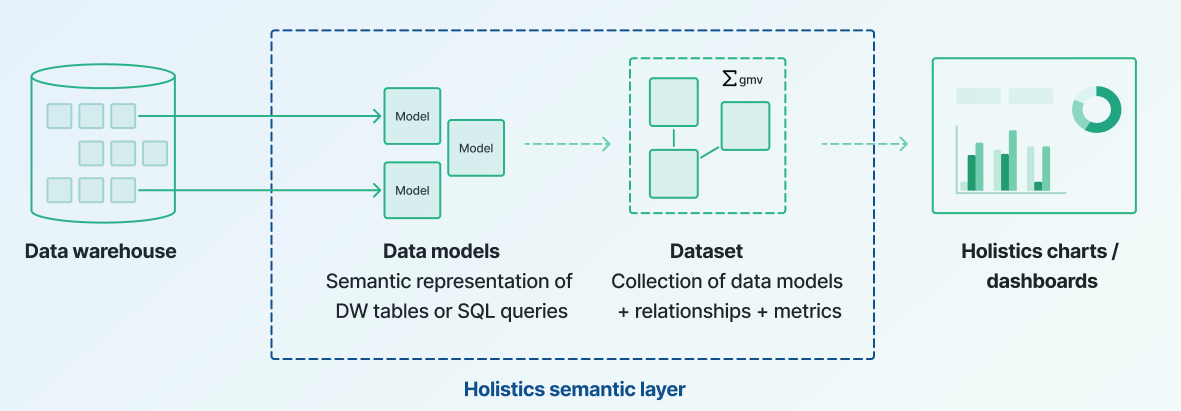
The semantic layer is the layer between your warehouse and everything that consumes data (dashboards, AI, embedded analytics, self-service). It's where models, dimensions, measures, datasets, and relationships are defined as composable code objects, and it's the substrate the rest of Holistics reasons from.
How it fits together
Holistics's semantic layer is written in AML, a typed language purpose-built for analytics modeling. The diagram below shows where it sits: between your data sources and everything that consumes data.
The semantic layer is written in AML, a typed language purpose-built for analytics modeling: first-class language constructs for models, datasets, and relationships, not YAML key-value structures.
The companion query language AQL queries the semantic layer, and it gets its own section.
What's in this section
The flow runs setup → language → building blocks → patterns → operations.
Set up and learn the language
Plumb your warehouse, then get to know AML before you start modeling.
Building blocks
The atoms of the semantic layer: models, relationships, and the datasets that make them self-service.
Patterns and reuse
Higher-level structures and the language features that keep large models DRY.
Operations
Operational knowledge for running a semantic layer in production.
Where to start
Pick the path that matches where you're coming from.